Therapy for Emotional Healing + Growth

Resources for Healing + Deeper Understanding

This space is an extension of the work we do at Joining with Empathy. Here you’ll find supportive articles, reflections, and carefully selected resources designed to help you feel more grounded, connected, and understood.


These writings are offered to support your emotional wellbeing and self-understanding, whether you are currently in therapy, considering starting, or simply looking for thoughtful guidance as you move through life. Everything shared here is rooted in our trauma-informed, relational approach to care.

Receive reflections and supportive resources in your inbox

Join our email list to receive thoughtful reflections, grounded insights, and gentle guidance from the Joining with Empathy team. When you sign up, you’ll also receive our free tool, Understanding Burnout & Overwhelm, created to help you slow down and make sense of what you’re carrying.


Hands gently holding a branch with dark green leaves and black berries.
Link to Resource
using ai for therapy
Link to Blog Post

Using AI for Therapy: Why ChatGPT Can’t Replace a Human Therapist

Artificial intelligence has entered nearly every corner of our daily lives—from writing emails to diagnosing illnesses, and now, even therapy.
Link to Resource
how to make an appointment for depression
Link to Blog Post

How to Make an Appointment for Depression Therapy in Baltimore

If you’ve been feeling hopeless, exhausted, or disconnected from the things you used to love, you’re not alone.
Link to Resource
seasonal changes
Link to Blog Post

Coping with Seasonal Changes: Finding Balance in Fall

Learning healthy ways of coping with seasonal changes can make this time of year feel more manageable and even restorative.
Link to Resource
benefits of couple therapy
Link to Blog Post

5 Key Benefits of Couples Therapy

Every relationship has its share of ups and downs, which is why exploring the benefits of couples therapy can be so valuable.
Link to Resource
mental health services
Link to Blog Post

How Therapy for Depression Can Change Your Life

At Joining with Empathy, we believe in normalizing conversations about how therapy
for depression can be truly life-changing.
Link to Resource
therapy for low esteem
Link to Blog Post

Therapy for Self-Esteem: Why It's a Must

Confidence is not something you’re either born with or without—it’s something you can build with the right support and guidance.
Link to Resource
benefits of online therapy
Link to Blog Post

The Benefits of Online Therapy

With a computer, tablet, or even a smartphone, you can now access high-quality counseling
from virtually anywhere.
Link to Resource
therapy for mental health
Link to Blog Post

Why Therapy for Mental Health Matters More Than Ever

Stress, anxiety, and depression are at an all-time high, and many people are searching for effective ways to find balance.
Link to Resource
how to choose the right therapist
Link to Blog Post

How to Choose the Right Therapist for You

The right fit can make all the difference
in your comfort, progress, and overall success
in therapy.
Link to Resource
burnout and stress
Link to Blog Post

Burnout Is More Than Just Stress: How Therapy Can Help You Recover

Burnout doesn’t always scream—it often whispers. It’s the constant fatigue, the irritability, the feeling of going through the motions.
Link to Resource
couples counseling near me
Link to Blog Post

Relationship Counseling: How Therapy Can Help You Reconnect

Relationships are one of the most meaningful parts of life—and at times, one of the most challenging. Even loving, committed couples can struggle with communication, intimacy, or navigating major life changes.
Link to Resource
how to start therapy
Link to Blog Post

How to Start Therapy: A Beginner's Guide to Mental Health

You might be wondering: How do you begin, what do you say, and how do you even know if it’s the right time? The truth is, you don’t need to have all the answers before reaching out for help.

Ready to Begin?

Curated Resources + Links

A small and carefully curated collection of practical tools and supportive resources recommended by the Joining with Empathy team. These are designed to help you feel grounded, supported, and connected beyond sessions.

Grounding Relaxation Techniques

Calm your central nervous system & return to the present moment.

5-4-3-2-1 Grounding Exercise

USE YOUR SENSES TO BECOME FULLY PRESENT: 5 things you can see, 4 things you can touch, 3 things you can hear, 2 things you can smell, 1 thing you can taste or feel internally.

Self-Soothing with the Senses

SIGHT: calming images or nature walks.
SOUND: music, white noise, or rain sounds.
TOUCH: soft blanket, textured object.
SMELL: essential oils or fresh scents.
TASTE: peppermint tea, lemon water, grounding snacks.

Box Breathing (4-4-4-4)

Inhale for 4 seconds → Hold for 4 → Exhale for 4 → Hold for 4. Repeat 3–5 rounds.

Mindfulness + Meditation

Simple practices to calm your mind and create space for clarity.

Helpful Apps

INSIGHT TIMER: Free meditations & sound baths.


HEADSPACE OR CALM: Great for anxiety and sleep.


MINDFUL MOMENTS: Set reminders on your phone or work calendar throughout the day to pause, check in, and breathe.

Setting Reminders

MINDFUL MOMENTS: Set reminders throughout the day to pause, check in, and breathe.


WALKING MEDITATIONS: Focus on your breath and surroundings as you move.

Box Breathing (4-4-4-4)

Inhale for 4 seconds → Hold for 4 → Exhale for 4 → Hold for 4. Repeat 3–5 rounds.

Emotion Regulation Tools

Skills for riding out intense emotions.

Distress Tolerance Tool - TIPP

The TIPP skills are quick techniques designed to regulate emotions by shifting your body’s chemistry:


T - Extreme Temperature - Cold Splash


I - Intense Exercise - Jumping Jacks


P - Paced Breathing - Paced Breathing (use the breathing exercises above)


P - Progressive Muscle Relaxation - Tense your body parts then let them relax.

Distress Tolerance Tool - ACCEPTS

When you’re overwhelmed by emotions, you can distract yourself in healthy ways using the ACCEPTS skills:


A – Activities
Do something that engages your mind or body (e.g., read, clean, play a game, go for a walk).


C – Contributing
Shift focus by helping someone else (e.g., volunteer, call a friend, do a small favor).


C – Comparisons
Remind yourself of times you’ve gotten through worse, or compare your situation to others who have faced difficulties and survived.


E – Emotions (Opposite)
Do something that sparks the opposite emotion of what you’re feeling (e.g., watch a funny video when sad, listen to calming music when angry).


P – Pushing Away
Temporarily set aside the distressing situation in your mind; give yourself permission to return to it later.


T – Thoughts
Distract with mental activities (e.g., puzzles, reading, counting, reciting song lyrics or prayers).


S – Sensations
Use your senses to ground yourself (e.g., hold ice, take a hot shower, squeeze a stress ball, smell something calming).

Who We Work With

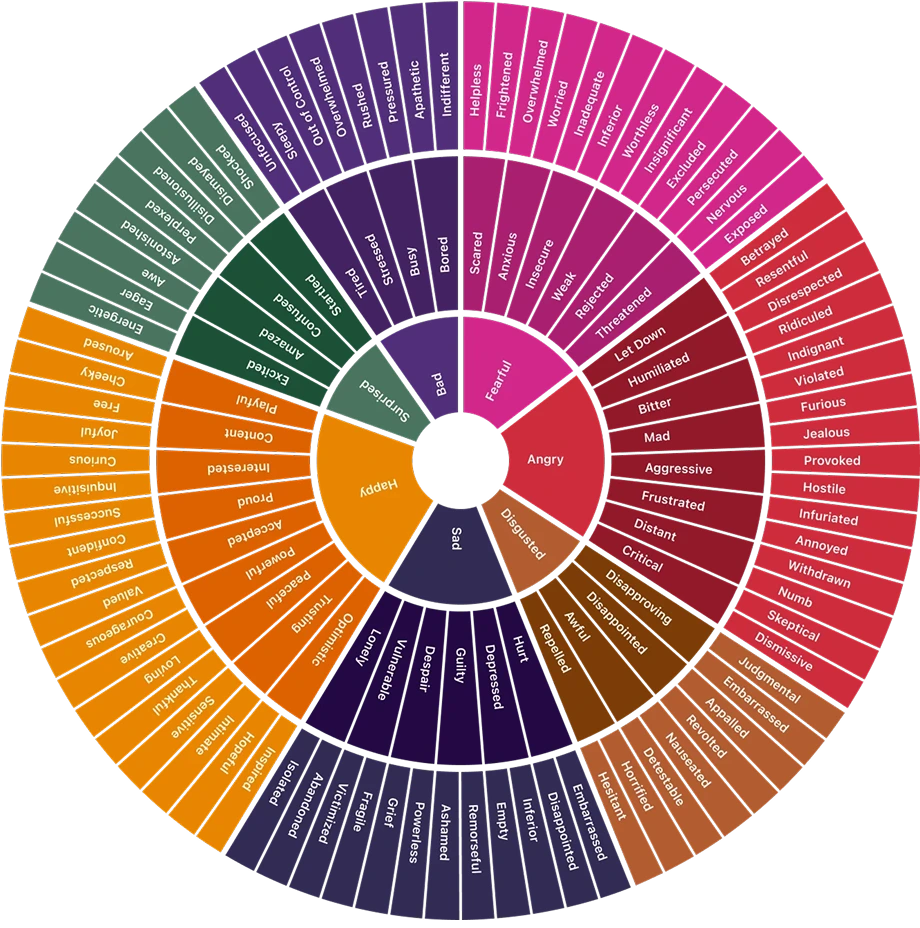
Struggling to Name How You Feel?

THE FEELINGS WHEEL is a powerful mental health tool designed to help you move beyond vague labels like “good” or “bad” and find the exact words that describe your emotional state.

By starting with broad categories, such as sadness, anger, joy, or fear, and working your way into more specific words, the wheel makes it easier to recognize the full depth of what you’re experiencing.

Why is this important? Naming your emotions is the first step toward managing them.